Electric vs petrol: what does each really cost to run?
A yearly fuel bill for a petrol car and an electric car at the same mileage, and the one factor that decides which is cheaper.
Updated September 5, 2026
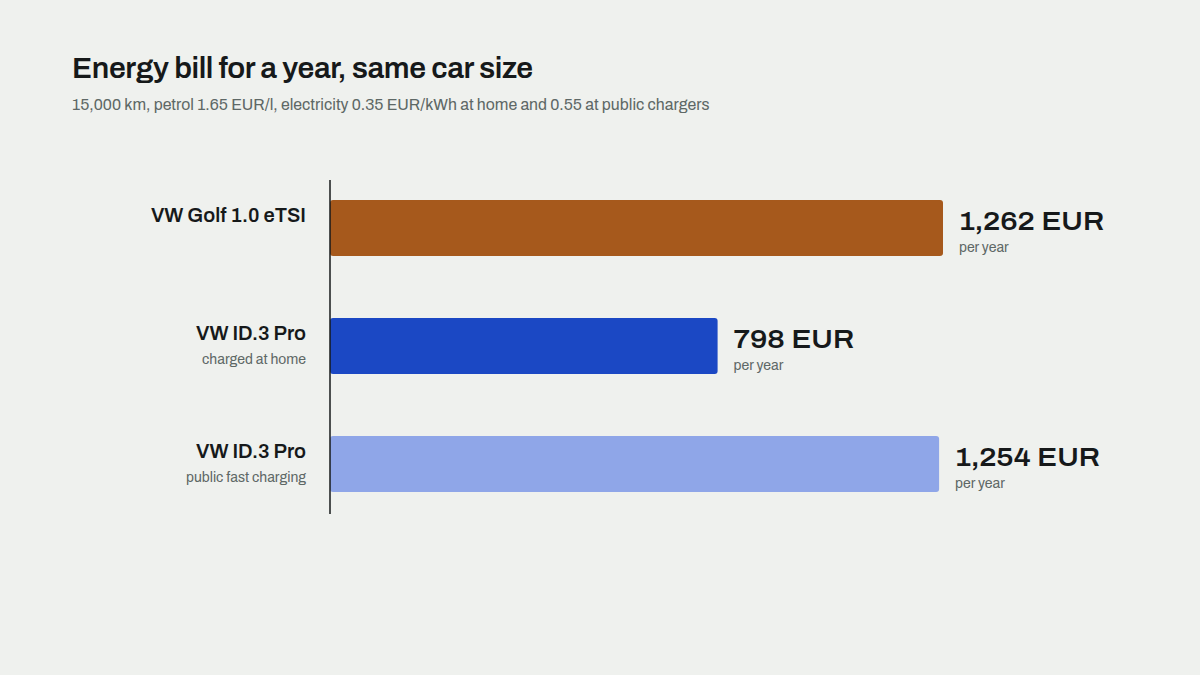
At the same yearly distance, an electric car charged at home costs roughly a third less in energy than a comparable petrol car; charged mostly at public fast chargers, the two end up close to level. The difference is not the car, it is the price you pay per kilowatt-hour, so the honest answer to "which is cheaper to run" is "where do you charge".
The formula
Running cost for fuel or electricity is the same calculation for any car:
cost = consumption / 100 x kilometres x price
Consumption is the WLTP combined figure in l/100 km or kWh/100 km, kilometres is your yearly distance, and price is what you pay per litre or per kilowatt-hour. This site uses 15,000 km a year, petrol at 1.65 EUR per litre, diesel at 1.55 EUR per litre and electricity at 0.35 EUR per kWh as defaults, with home charging around 0.30 EUR and public fast charging around 0.55 EUR per kWh. All of these can be changed in the compare tool.
A worked example
Two cars from the same brand and size class, both from this site's data:
| VW Golf 1.0 eTSI DSG | VW ID.3 Pro | |
|---|---|---|
| WLTP combined | 5.1 l/100 km | 15.2 kWh/100 km |
| Per 100 km at default prices | 8.42 EUR | 5.32 EUR (home) |
| Per year, 15,000 km | about 1,262 EUR | about 798 EUR (home) |
| Per year, public charging at 0.55 EUR | about 1,254 EUR |
Charged at home, the electric car saves about 460 EUR a year on energy. Charged only at public fast chargers, it saves almost nothing. Most owners land somewhere between, which is why the compare tool asks for a home charging share.
What moves the result
- Charging mix. The biggest lever by far. Home or workplace charging at a household tariff makes the electric case; relying on motorway fast chargers unmakes it.
- Prices. Petrol and electricity prices move independently. The figures above are averages for a moment in time; use your own tariff and local pump price.
- Driving pattern. Electric cars are at their best in town, where petrol cars are at their worst. On the motorway the gap narrows because the electric car's consumption rises faster with speed.
- Winter. Heating an electric car comes out of the battery. Expect 20 to 30% more consumption in cold months; the petrol car loses less.
- The real-world gap. Both figures above are WLTP. Real use adds around 20% for the petrol car and a similar order for the electric car; the ranking rarely flips. The guide on WLTP vs real-world consumption explains why.
What this does not include
This is the energy bill only. Purchase price, depreciation, tax, insurance, servicing and tyres can each be larger than the fuel difference, and they cut both ways: electric cars often cost more to buy and less to service. The premium version of the compare tool adds depreciation over your ownership period to give a total cost of ownership; the free version answers the fuel question, which is the one people ask first.
Check it for your car
Pick the cars you are actually deciding between, add them to the compare tool, and set your distance, your tariff and your home charging share. Start from the rankings if you want the most economical cars in a class, or from a model page such as Volkswagen Golf to see every variant side by side.