Is a plug-in hybrid worth it?
When a plug-in hybrid saves money, when it is just a heavier petrol car, and how to find out for your own commute.
Updated September 5, 2026
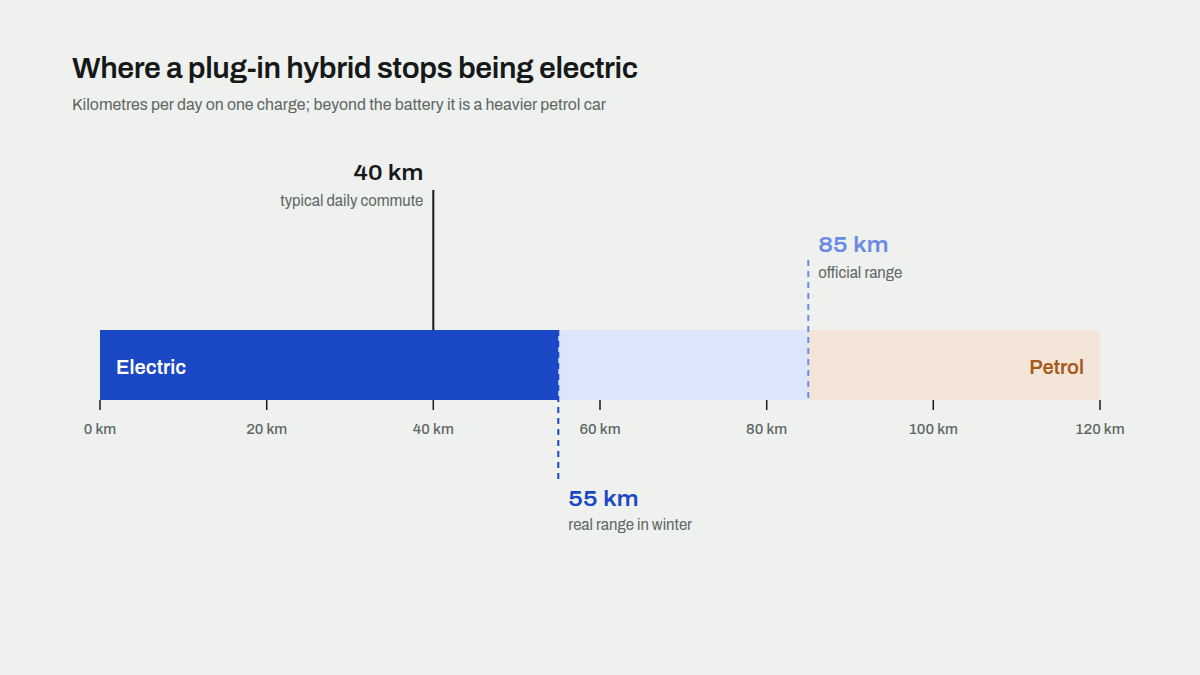
A plug-in hybrid is worth it when your daily driving fits inside its real electric range and you can charge it at home or at work, and it is not worth it otherwise. That sounds obvious, but the official consumption figure hides it, and a lot of plug-ins are bought on a number their owners never see again.
How a plug-in hybrid actually uses energy
A plug-in hybrid has a petrol engine and a battery big enough for typically 50 to 100 km of electric driving on the WLTP test. In real use that range is 20 to 40% shorter, and shorter still in winter. Once the battery is empty the car runs on petrol, carrying a battery and motor it is no longer using, so its fuel consumption is a little higher than a comparable non-hybrid petrol car.
So the car has two consumption figures that matter, and the official combined figure is neither of them:
- Electric consumption, in kWh/100 km, for the kilometres inside the battery's range.
- Fuel consumption with the battery empty, in l/100 km, for everything beyond it.
This site shows the second one on every plug-in's car page, labelled "battery empty", because it is the figure you get if you do not charge. The compare tool then blends the two using your own trips.
When it pays off
| Your situation | Verdict |
|---|---|
| Daily commute under about 40 km, charging at home or work every night | Most kilometres electric; a plug-in can be the cheapest option to run |
| Commute 40 to 80 km, charging at home | Depends on real range in winter; run the numbers |
| Charging only at public chargers | Rarely worth the effort; the car mostly runs on petrol |
| Long motorway commutes | A diesel or an efficient petrol car is usually cheaper and simpler |
| Company car chosen for its tax rating | Cheap for you, but only cheap to run if you charge it |
| Frequent short trips plus occasional long ones, home charging | The best case for a plug-in: electric daily, petrol on holiday |
Why the official figure misleads
The WLTP figure for a plug-in hybrid, usually around 1.6 to 1.7 l/100 km, assumes a high share of electric driving. The European Commission's first report on real-world data found plug-ins using about 5.9 l/100 km on average, roughly three and a half times the official value, because drivers charged far less than the test assumed. From 2025 the EU lowered that assumed electric share, so newer official figures are higher without the cars changing, and they will rise again in 2027.
None of that makes the car bad. It makes the average owner someone who does not plug in. If you would, the arithmetic is different from the average, and that is exactly what a personal calculation is for.
Run your own numbers
The compare tool's plug-in model takes your commute distance and days per week, plus any regular longer trips, and works out how many of your kilometres would be electric and how many on petrol. It then prices both parts with your electricity tariff and pump price. Put a plug-in next to the equivalent petrol or diesel version of the same model and the yearly difference is the answer; if it is small, choose on other grounds.
Check it for your car
The plug-in hybrid rankings list the most economical plug-ins by their battery-empty fuel figure, which is the honest starting point. Open a model page such as Volkswagen Golf to see the plug-in next to its petrol and diesel siblings, and take them to the compare tool with your own commute.